
Calling R libraries from Python
In this example we will explore the Coral Reef Evaluation and Monitoring Project (CREMP) data available in the Gulf of Mexico Coastal Ocean Observing System (GCOOS) ERDDAP server.
To access the server we will use the rerddap library and export the data to Python for easier plotting.
The first step is to load the rpy2 extension that will allow us to use the R libraries.
%load_ext rpy2.ipython
The first line below has a %%R to make it an R cell. The code below specify the GCOOS server and fetches the data information for the cremp_fk_v2_1996 dataset.
For more information on rerddap please see https://rmendels.github.io/Using_rerddap.nb.html.
%%R

library('rerddap')

url <- 'http://gcoos4.tamu.edu:8080/erddap/'
data_info <- rerddap::info('cremp_fk_1996_v20', url=url)

data_info
<ERDDAP info> cremp_fk_1996_v20
 Dimensions (range):
 Variables:
     AverageNumberOfPoints:
         Range: 1045, 2625
     basisOfRecord:
     bottomType:
     class:
     country:
     datasetID:
     datasetName:
     depth:
         Range: 3.0, 54.0
         Units: m
     dynamicProperties:
     eventDate:
     eventDateRemarks:
     eventDateTimeZone:
     family:
     firstYear:
         Range: 1996, 1996
     genus:
     geodeticDatum:
     habitat:
     higherInstitutionCode:
     institutionCode:
     kingdom:
     lastYear:
         Range: 2000, 2015
     latitude:
         Range: 24.4517, 25.2953
         Units: degrees_north
     locality:
     longitude:
         Range: -81.9195, -80.2087
         Units: degrees_east
     materialSampleID:
     maximumDepthInMeters:
         Range: 3.0, 54.0
         Units: m
     minimumDepthInMeters:
         Range: 3.0, 54.0
         Units: m
     order:
     ownerInstitutionCode:
     phylum:
     protection:
     quantificationMethod:
     quantificationName:
     quantificationStatus:
     quantificationUnit:
     quantificationValue:
         Range: 0.0, 0.919800885
     recordedBy:
     region:
     sampleAreaInSquareMeters:
         Range: 19.0, 26.0
         Units: m^2
     Samples:
         Range: 0, 11679
     scientificName:
     scientificNameAuthorship:
     scientificNameIDITIS:
         Range: -999, 914166
     scientificNameIDWoRMS:
         Range: -999, 828326
     specificEpithet:
     stateProvince:
     stationNumber:
         Range: 101, 814
     subSampleID:
     taxonRank:
     time:
         Range: 8.204544E8, 8.204544E8
         Units: seconds since 1970-01-01T00:00:00Z
     timeUncertainty:
         Units: sec
     underwaterVisibilityInMeters:
     vernacularName:
     verticalDatum:
     waterBody:
     waterTemperatureInCelsius:
         Units: C
By inspecting the information above we can find the variables available in the dateset and use the tabledap function to download them.
Note that the %%R -o rdf will export the rdf variable back to the Python workspace.
%%R -o rdf

fields <- c(
    'Samples',
    'depth',
    'time',
    'longitude',
    'latitude',
    'scientificName',
    'habitat',
    'genus',
    'quantificationValue'
)

rdf <- tabledap(
    data_info,
    fields=fields,
    url=url
)
Now we need to export the R DataFrame to a pandas objects and ensure that all numeric types are numbers and not strings.
import pandas as pd

from rpy2.robjects import pandas2ri

pandas2ri.activate()
df = pandas2ri.ri2py_dataframe(rdf)

cols = ["longitude", "latitude", "depth", "quantificationValue"]
df[cols] = df[cols].apply(pd.to_numeric)

df.head()
| Samples | depth | time | longitude | latitude | scientificName | habitat | genus | quantificationValue | |
|---|---|---|---|---|---|---|---|---|---|
| 2 | 0 | 6.0 | 1996-01-01T00:00:00Z | -80.3475 | 25.1736 | Acropora cervicornis | Hard Bottom | Acropora | 0.0 |
| 3 | 1 | 6.0 | 1996-01-01T00:00:00Z | -80.3475 | 25.1736 | Acropora cervicornis | Hard Bottom | Acropora | 0.0 |
| 4 | 2 | 6.0 | 1996-01-01T00:00:00Z | -80.3475 | 25.1736 | Acropora cervicornis | Hard Bottom | Acropora | 0.0 |
| 5 | 3 | 6.0 | 1996-01-01T00:00:00Z | -80.3475 | 25.1736 | Acropora cervicornis | Hard Bottom | Acropora | 0.0 |
| 6 | 4 | 9.0 | 1996-01-01T00:00:00Z | -80.3782 | 25.1201 | Acropora cervicornis | Hard Bottom | Acropora | 0.0 |
We can navigate to ERDDAP’s info page to find the variables description. Let’s check what is quantificationValue:
The is value of the derived information product, such as the numerical value for biomass. This term does not include units. Mean number of observed fish per species for 5 Minutes
We can see that quantificationValue has a lot of zero values,
let’s remove that first to plot the data positions only where something was found.
# Filter invalid values (-999).

cremp_1996 = df.loc[df["quantificationValue"] >= 0]
cremp_1996.head()
| Samples | depth | time | longitude | latitude | scientificName | habitat | genus | quantificationValue | |
|---|---|---|---|---|---|---|---|---|---|
| 2 | 0 | 6.0 | 1996-01-01T00:00:00Z | -80.3475 | 25.1736 | Acropora cervicornis | Hard Bottom | Acropora | 0.0 |
| 3 | 1 | 6.0 | 1996-01-01T00:00:00Z | -80.3475 | 25.1736 | Acropora cervicornis | Hard Bottom | Acropora | 0.0 |
| 4 | 2 | 6.0 | 1996-01-01T00:00:00Z | -80.3475 | 25.1736 | Acropora cervicornis | Hard Bottom | Acropora | 0.0 |
| 5 | 3 | 6.0 | 1996-01-01T00:00:00Z | -80.3475 | 25.1736 | Acropora cervicornis | Hard Bottom | Acropora | 0.0 |
| 6 | 4 | 9.0 | 1996-01-01T00:00:00Z | -80.3782 | 25.1201 | Acropora cervicornis | Hard Bottom | Acropora | 0.0 |
What is the most common genus of Coral observed?
avg = cremp_1996.groupby("genus").mean()

avg
| Samples | depth | longitude | latitude | quantificationValue | |
|---|---|---|---|---|---|
| genus | |||||
| 8010.928571 | 23.2375 | -81.046667 | 24.768957 | 0.128788 | |
| Acropora | 159.500000 | 23.2375 | -81.046667 | 24.768957 | 0.005494 |
| Agaricia | 479.500000 | 23.2375 | -81.046667 | 24.768957 | 0.000003 |
| Cladocora | 719.500000 | 23.2375 | -81.046667 | 24.768958 | 0.000000 |
| Colpophyllia | 879.500000 | 23.2375 | -81.046667 | 24.768958 | 0.004462 |
| Dendrogyra | 1039.500000 | 23.2375 | -81.046667 | 24.768958 | 0.000977 |
| Diadema | 10159.500000 | 23.2375 | -81.046667 | 24.768958 | 0.000007 |
| Dichocoenia | 1199.500000 | 23.2375 | -81.046667 | 24.768958 | 0.000509 |
| Diploria | 1359.500000 | 23.2375 | -81.046667 | 24.768958 | 0.000999 |
| Eusmilia | 1519.500000 | 23.2375 | -81.046667 | 24.768958 | 0.000091 |
| Favia | 1679.500000 | 23.2375 | -81.046667 | 24.768958 | 0.000045 |
| Helioseris | 1839.500000 | 23.2375 | -81.046667 | 24.768958 | 0.000004 |
| Isophyllia | 2079.500000 | 23.2375 | -81.046667 | 24.768957 | 0.000006 |
| Madracis | 2399.500000 | 23.2375 | -81.046667 | 24.768957 | 0.000040 |
| Manicina | 2639.500000 | 23.2375 | -81.046667 | 24.768958 | 0.000007 |
| Meandrina | 2799.500000 | 23.2375 | -81.046667 | 24.768958 | 0.000363 |
| Millepora | 3039.500000 | 23.2375 | -81.046667 | 24.768957 | 0.006159 |
| Montastraea | 3279.500000 | 23.2375 | -81.046667 | 24.768958 | 0.013597 |
| Mussa | 3439.500000 | 23.2375 | -81.046667 | 24.768958 | 0.000061 |
| Mycetophyllia | 3759.500000 | 23.2375 | -81.046667 | 24.768957 | 0.000144 |
| Oculina | 4159.500000 | 23.2375 | -81.046667 | 24.768957 | 0.000046 |
| Orbicella | 4399.500000 | 23.2375 | -81.046667 | 24.768958 | 0.033860 |
| Other | 10319.500000 | 23.2375 | -81.046667 | 24.768958 | 0.000161 |
| Porites | 4639.500000 | 23.2375 | -81.046667 | 24.768957 | 0.003372 |
| Pseudodiploria | 4959.500000 | 23.2375 | -81.046667 | 24.768957 | 0.001024 |
| Scolymia | 5359.500000 | 23.2375 | -81.046667 | 24.768958 | 0.000009 |
| Siderastrea | 5599.500000 | 23.2375 | -81.046667 | 24.768957 | 0.004603 |
| Solenastrea | 5919.500000 | 23.2375 | -81.046667 | 24.768957 | 0.000048 |
| Stephanocoenia | 6159.500000 | 23.2375 | -81.046667 | 24.768958 | 0.000263 |
| Undaria | 6319.500000 | 23.2375 | -81.046667 | 24.768958 | 0.001044 |
rerddap’s info request does not have enough metadata about the variables to explain the blank, and most abundant, genus. Checking the sever did not help figure that out. We’ll remove that for now to deal with only those that are identified.
cremp_1996 = cremp_1996.loc[cremp_1996["genus"] != ""]
There are also many genus with zero biomass count. In this example we’ll choose to do a biased analysis of occurrence and eliminate those where nothing was observed.
# Filter zero values (nothing was observed).

cremp_1996 = cremp_1996.loc[cremp_1996["quantificationValue"] > 0]
Now we can check the quantificationValue average by genus.
%matplotlib inline

avg = cremp_1996.groupby("genus").mean()  # re-compute the "biased" average.
ax = avg["quantificationValue"].plot(kind="bar")
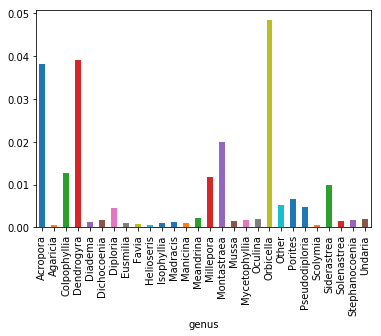
and habitat.
ax = cremp_1996.groupby("habitat").mean()["quantificationValue"].plot(kind="bar")
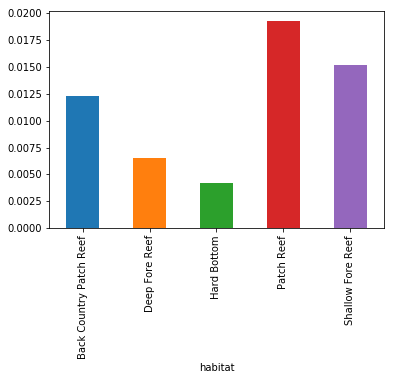
It seems the most of the biomass was found around the Dendrogyra genus in Patch Reef habitats.
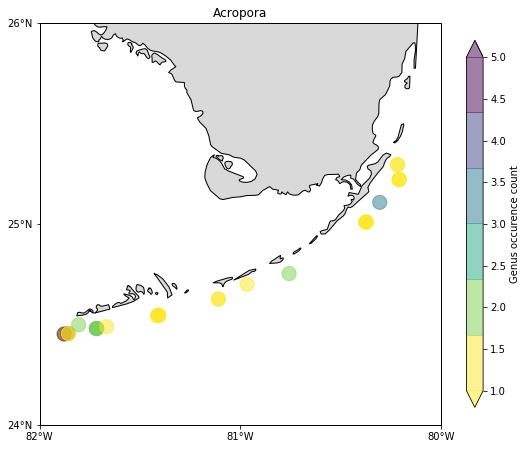
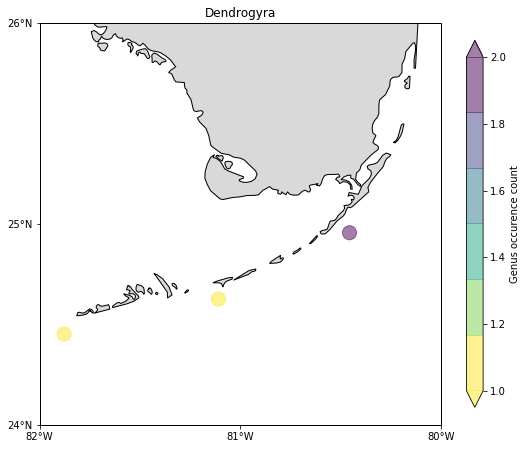
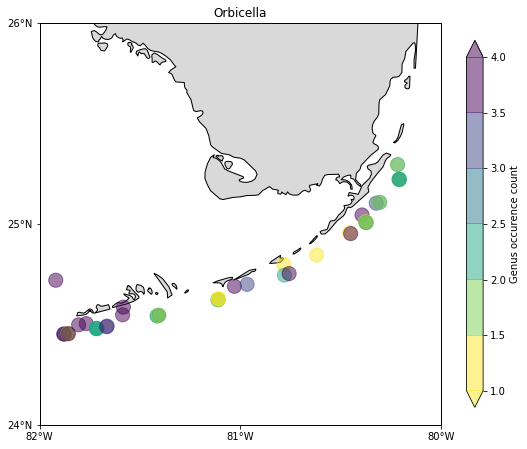
But where are those Coral Reefs? How is the distribution of top three species with more biomass around them?
With a pandas DataFrame it is easy to group the data by location and count the genus occurrence based on it.
import cartopy.crs as ccrs
import cartopy.feature as cfeature
import matplotlib.pyplot as plt
import numpy as np
from cartopy.mpl.ticker import LatitudeFormatter, LongitudeFormatter


def make_plot():
    bbox = [-82, -80, 24, 26]
    projection = ccrs.PlateCarree()

    fig, ax = plt.subplots(figsize=(9, 9), subplot_kw=dict(projection=projection))

    ax.set_extent(bbox)

    land = cfeature.NaturalEarthFeature(
        "physical", "land", "10m", edgecolor="face", facecolor=[0.85] * 3
    )

    ax.add_feature(land, zorder=0)
    ax.coastlines("10m", zorder=1)

    ax.set_xticks(np.linspace(bbox[0], bbox[1], 3), crs=projection)
    ax.set_yticks(np.linspace(bbox[2], bbox[3], 3), crs=projection)
    lon_formatter = LongitudeFormatter(zero_direction_label=True)
    lat_formatter = LatitudeFormatter()
    ax.xaxis.set_major_formatter(lon_formatter)
    ax.yaxis.set_major_formatter(lat_formatter)
    return fig, ax
count = (
    cremp_1996.loc[cremp_1996["genus"] == "Acropora"]
    .groupby(["longitude", "latitude"])
    .count()
    .reset_index()
)


fig, ax = make_plot()
c = ax.scatter(
    count["longitude"],
    count["latitude"],
    s=200,
    c=count["genus"],
    alpha=0.5,
    cmap=plt.cm.get_cmap("viridis_r", 6),
    zorder=3,
)
cbar = fig.colorbar(c, shrink=0.75, extend="both")
cbar.ax.set_ylabel("Genus occurrence count")
ax.set_title("Acropora")
count = (
    cremp_1996.loc[cremp_1996["genus"] == "Dendrogyra"]
    .groupby(["longitude", "latitude"])
    .count()
    .reset_index()
)


fig, ax = make_plot()
c = ax.scatter(
    count["longitude"],
    count["latitude"],
    s=200,
    c=count["genus"],
    alpha=0.5,
    cmap=plt.cm.get_cmap("viridis_r", 6),
    zorder=3,
)
cbar = fig.colorbar(c, shrink=0.75, extend="both")
cbar.ax.set_ylabel("Genus occurrence count")
ax.set_title("Dendrogyra")
count = (
    cremp_1996.loc[cremp_1996["genus"] == "Orbicella"]
    .groupby(["longitude", "latitude"])
    .count()
    .reset_index()
)


fig, ax = make_plot()
c = ax.scatter(
    count["longitude"],
    count["latitude"],
    s=200,
    c=count["genus"],
    alpha=0.5,
    cmap=plt.cm.get_cmap("viridis_r", 6),
    zorder=3,
)
cbar = fig.colorbar(c, shrink=0.75, extend="both")
cbar.ax.set_ylabel("Genus occurrence count")
ax.set_title("Orbicella")
This demonstration showed the power of mixing Python and R to reduce developer time and allow the research to focus on the data and not the programming language.